Managing a small number of pet sitting clients can be relatively straightforward. You may know each owner's routine, remember which pets belong to which household and have a simple system for keeping notes.
As your business grows, however, that becomes much harder.
You may be looking after dozens of pets across different households, each with their own routines, preferences, care requirements and client details. Finding the right information quickly becomes just as important as providing the care itself.
A pet sitting app can help by bringing client and pet records together in one organised system. Instead of relying on separate notebooks, spreadsheets, messages or memory, you can keep the information relating to each client and their pets together and access it when you need it.
For UK pet sitters and dog walkers, this can make managing a growing client base considerably easier.
Why managing multiple pets and clients can become difficult
A pet sitting business doesn't simply involve keeping a list of customers.
Each client relationship can involve several pieces of information, while one household may have two, three or even more pets with completely different requirements.
For example, one client might have:
- A Labrador that needs two daily walks
- An older cat with a specific feeding routine
- A puppy that needs regular toilet breaks
- Different instructions for each animal
As the number of households you work with increases, remembering which information belongs to which pet becomes increasingly difficult.
The challenge isn't necessarily collecting the information. It's keeping it organised and being able to find the correct information when you need it.
What information might you need to manage for each client?
A professional pet sitter may need to keep track of more than just a client's name and telephone number. Depending on the services you provide, you may need to record their contact details, home address, access or key-holding information and preferred communication details.
You may also need to keep emergency contact details, booking-related notes, special instructions and relevant documents or agreements. Having these details organised within the client's record means you have a clearer reference point whenever you need to check something.
Keeping client information together also means you don't have to search through old messages, separate documents or different notes every time you need to find a particular detail. More importantly, it gives you a consistent way to manage information as you take on new clients and your pet care business grows.
One client can have several pets
One of the complications of a growing pet sitting business is that clients and pets aren't always a one-to-one relationship.
A single household might have several animals, each with different needs.
For example:
The Smith household
- Max – Labrador – daily walks
- Luna – cat – evening feeding
- Archie – rabbit – morning feeding and enclosure check
The client's contact details are shared, but the information relating to each animal is different.
A system that allows individual pet records to sit alongside the relevant client record makes this information easier to distinguish.
This reduces the need to maintain separate documents for every animal while helping you identify which instructions apply to which pet.
How a pet sitting app helps organise client and pet records
A dedicated Pet Sitting Software system can provide a central place for managing client and pet information.
Rather than maintaining a spreadsheet for clients, a notebook for pet details and separate messages containing care instructions, information can be organised around the relevant client and pet.
This can be particularly useful when your business starts to grow beyond a small number of regular customers.
1. Keep client details in one place
A centralised client record gives you one place to find the basic information associated with a household.
Instead of searching through previous emails or messages, you can refer to the client's record when you need to check their details.
This is especially useful when you're dealing with several clients on the same day.
2. Create individual records for each pet
Pets within the same household don't necessarily have the same routines.
Individual pet profiles allow information to be associated with the correct animal.
For example, you might need to distinguish between:
- A dog that requires a long walk
- A dog that needs shorter exercise
- A cat with a particular feeding routine
- A pet with specific behavioural instructions
Having individual records makes it easier to see the information relevant to the animal you're caring for.
3. Keep information connected to the right household
A pet's information is only useful if you know which client it belongs to.
Connecting pet profiles to client records helps create a clearer relationship between the household, the animals and the information associated with them.
This can be particularly helpful when you have similar pet names or several clients living in the same area.
4. Find information without searching through multiple systems
The more clients you have, the more difficult it becomes to remember where you recorded a particular piece of information.
It might be in:
- A WhatsApp conversation
- An email
- A spreadsheet
- A paper form
- Your phone's notes
- A notebook
Searching through all of these every time you need a detail can quickly become frustrating.
A centralised system gives you a consistent place to look instead.
What happens when your client list grows?
A system that works for ten clients may not work as well for fifty.
When your client base grows, you're not simply adding more names to a list. You're adding more pets, more addresses, more care instructions and more individual requirements.
This can make organisation increasingly important.
For example, imagine you're now responsible for 40 client households and 65 pets.
You may need to remember:
- Which pets belong to each household
- Which animals have specific dietary requirements
- Which pets need particular exercise routines
- Which clients have access instructions
- Which information applies to individual animals
- Which contact details belong to each household
Trying to keep all of this information in your head isn't realistic.
A structured record-keeping system gives you somewhere reliable to refer back to.
Why individual pet profiles matter
It can be tempting to treat a household as one client record, particularly when you first start your business.
However, the animals you're caring for may have completely different requirements.
Individual profiles allow you to distinguish between them.
For example:
Bella: nervous around unfamiliar dogs and prefers quieter walks.
Milo: requires food at 6pm and should not be given certain treats.
Both pets belong to the same household, but the instructions are specific to each animal.
Keeping this information attached to the relevant pet makes it easier to provide consistent care without relying entirely on memory.
Keeping track of pets when you're working with other people
Managing multiple pets becomes even more complicated if your business has employees or other pet care professionals working with you.
A team member may be visiting a client for the first time and won't have the same familiarity with the household that you do.
Having client and pet information recorded in a central system can give authorised team members a clearer reference point.
This can help maintain consistency when responsibility for a pet moves between members of your team.
The goal isn't to replace good communication between team members. It's to make sure important information isn't dependent on one person's memory.
How mobile access can make client information easier to manage
Pet sitters and dog walkers spend much of their working day away from a desk.
You might be:
- Walking a dog in a park
- Travelling between appointments
- Visiting a client's home
- Meeting a new customer
- Preparing for your next visit
Being able to access relevant records from a mobile device means you don't necessarily have to wait until you're back at your computer to check client or pet information.
This can be particularly useful when you're working with a growing number of households and need to identify the right pet record quickly.
Having the right information available while you're out working can also help you save time and stay organised, particularly when you're moving between multiple appointments throughout the day.
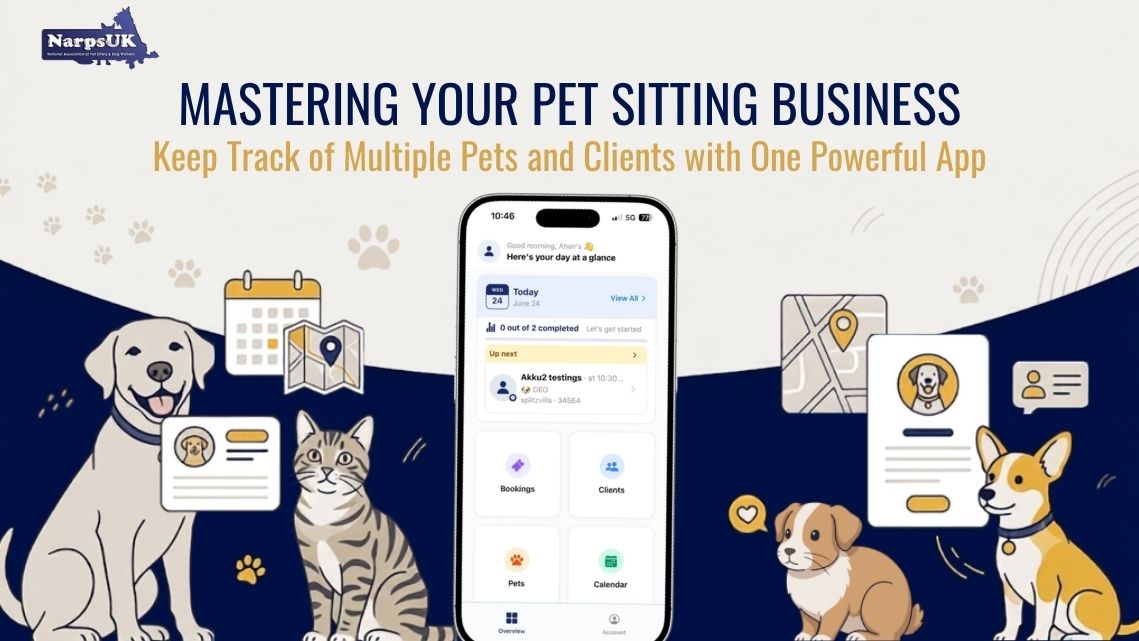
The NarpsUK system provides desktop and mobile access, with client and pet information available alongside other business tools.
Also Read : Running a Pet Sitting Business on the Go: How a Mobile App Can Help
Keeping information organised as you take on new clients
Good organisation becomes easier when it is built into your process from the beginning.
When a new client joins your business, you can establish a consistent approach to recording their information rather than deciding where to store each detail individually.
For each household, consider creating a structured record containing:
Client information
Contact details, address and relevant access information.
Pet information
Names, species, routines and individual care requirements.
Important notes
Anything specific that you need to know when providing the agreed service.
Supporting information
Relevant documents or other information associated with the client.
This approach creates a repeatable process that can continue working as your business grows.
A practical example of managing multiple pets
Imagine you have 25 clients and 40 pets.
One client has recently added a second dog. Another has asked you to start caring for their cat as well as their existing dog. A third client has introduced a puppy with a completely different routine from their older dog.
Without a structured system, each new animal means another set of notes to remember and another potential source of confusion.
With individual client and pet records, you can add the new animals to the relevant households and keep their information separate.
The benefit isn't simply having more digital records.
It's being able to find the right record, understand which pet it relates to and refer to the relevant information without searching through unrelated notes.
What should you look for in a pet sitting app?
Not every app is designed specifically for the needs of a pet care business.
If you're considering software for managing multiple clients and pets, look for features that support the way you actually work.
Useful capabilities may include:
- Individual pet profiles
- Client records
- Notes and special instructions
- Veterinary information
- Emergency contact information
- Document storage
- Mobile access
- Searchable records
- Information linked between clients and pets
It's also worth considering whether the system can grow with your business.
A tool that works for ten clients should ideally still be useful when you're managing 50 or 100.
Keeping client and pet information separate from your memory
Your knowledge of your clients is valuable, but a growing business shouldn't depend entirely on what you can remember.
You may know that one dog dislikes certain routes or that another pet needs a particular routine. But when you're tired, busy or covering several visits in one day, relying on memory alone becomes less dependable.
Recording information gives you a reference point you can return to. It can also make it easier for someone else to understand a pet's requirements if they're helping you with your business.
Using organised digital records can also support you in running a more professional business, particularly as your client base and responsibilities grow.
How NarpsUK can help you manage multiple pets and clients
NarpsUK's software is designed specifically for pet sitters, dog walkers and other pet care professionals. It provides client and pet profiles alongside bookings, scheduling and other business management tools, so you can manage information within one system.
The system supports client records and individual pet information, including details such as veterinary information, emergency contacts, medication records and documents.
This means you can build a more structured record of the households and animals you care for rather than relying on separate spreadsheets, notes and paperwork.
For businesses that are growing, that centralised approach can make it easier to keep track of more clients and pets without making information management unnecessarily complicated.
Keep Your Clients & Pets Organised
Download the NarpsUK app on iOS or Android.
Final thoughts
Managing multiple pets and clients is one of the challenges that comes with growing a pet sitting or dog walking business.
The more households you work with, the more information you need to keep organised. Client details, individual pet requirements, notes and supporting information all need to be easy to identify and access.
A pet sitting app can help by bringing this information into a structured system, allowing you to keep individual pet records connected to the correct clients and access them when needed.
The aim isn't simply to collect more information. It's to make sure the right information is connected to the right pet and easy to find when you need it.
For a growing pet care business, that can make managing a larger client base considerably more manageable.